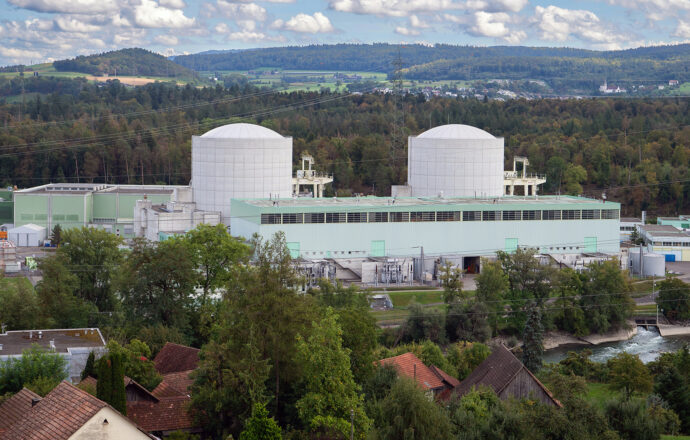

Nuclear installations with low hazard potential do not require a general licence. This is stated in the Nuclear Energy Act (Art. 12 para. 3 NEA). The Federal Council has specified this requirement in more detail in the Nuclear Energy Ordinance (Art. 22 NEO). According to this, nuclear installations do not require a general licence if, among other things, the frequency of all accidents with a resulting dose of more than 1 mSv for members of the public is no more than 10-6 per year.
The question of whether a nuclear installation has a low hazard potential is only relevant at the legal level in terms of the general licensing obligation. If it is a nuclear installation with low hazard potential, a construction and operating licence is required. In this case, a general licence is not necessary.
The Federal Council has deliberately set high requirements for proof of a low hazard potential, since without a general licence procedure, no politically broad-based decision on the nuclear installation is necessary. The corresponding participation opportunities are no longer available.
Irrespective of the licensing procedure, the operator of a nuclear installation with low hazard potential must ensure safety and security. The protection of people and the environment has highest priority.
Guideline ENSI-A05 (Chapter 7.1 Research reactors and interim storage facilities) regulates which probabilistic analyses are to be carried out as part of the risk-technical implementation. Due to the lack of application examples, ENSI has not yet regulated the comprehensive requirements for the methodology and boundary conditions for the required accident analyses in a separate guideline. As it is PSI’s intention to build a nuclear installation with low hazard potential, ENSI has specified the prerequisites.