More investigations are needed on the reactor pressure vessel of Beznau 1
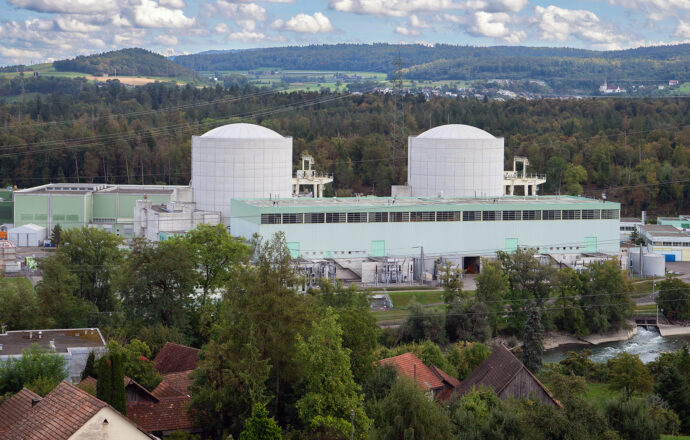
While carrying out ultrasonic measurements of the reactor pressure vessel of the Beznau 1 nuclear power plant the operator detected flaw indications that require evaluation. It submitted a corresponding report to the Swiss Federal Nuclear Safety Inspectorate ENSI yesterday. Beznau 1 is presently inactive because of the main annual overhaul. ENSI is now awaiting an assessment of these findings by Axpo. Operation of Beznau 1 may only be started again if the safety of the reactor pressure vessel is confirmed.
“There is no time pressure at Beznau 1, explains Georg Schwarz, Deputy Director of ENSI and Director of the Division for Nuclear Power Plants, because the nuclear power plant is currently switched off for the annual overhaul and the reactor core is unloaded. “Of course we will only issue the permission to restart Beznau 1 once we are certain that the findings do not represent any impairment of safety”, he stressed further.
ENSI has now instructed the operator to examine and assess the ultrasonic indications in more detail. This examination has to include the following three steps:
A detailed evaluation of the ultrasound results is the precondition for the fracture mechanics analysis of the indications and the safety case of RPV Beznau 1. . The aim is to gain the most comprehensive and reliable information possible from the measurement results. In particular the size and location of the ultrasound indications must now be examined more closely.
In the second phase of the examination, the aim is to characterise the type and cause of the findings.
Finally one has to examine how the reactor pressure vessel may have been weakened because of the findings, and whether it still meets the regulatory requirements.
Following the discovery in 2012 of material defects in the reactor pressure vessels at the Belgian nuclear power plants Doel 3 and Tihange 2, in January 2013 ENSI ordered that the manufacturing documents for the Swiss nuclear power plants should be inspected. The documents for the reactor pressure vessel of Beznau 1 did not indicate that there were any faults in the material.
In summer 2012 numerous material defects in the base material of the forged reactor pressure vessels were detected in the Belgian nuclear power plants Doel 3 and Tihange 2.
In response to these material defects, in summer 2013 the Western European Nuclear Regulators‘ Association WENRA recommended that all forged reactor pressure vessels in Europe should be inspected as part of the normal weld seam inspections. Therefore ENSI directed that during the next recurring inspection of the weld seams of the reactor pressure vessels, the Beznau and Gösgen nuclear power plants should also inspect the base material.
The Mühleberg nuclear power plant had already carried out this inspection in summer 2012 following the requirements of ENSI. No reportable ultrasound indications were found in the reactor pressure vessels during this inspection.
The Gösgen nuclear power plant carried out this inspection during the annual overhaul in 2015, and did not find any relevant indications either.
The examination of the findings at Doel 3 and Tihange 2 is of little significance for the reactor pressure vessel of the Leibstadt nuclear power plant. This reactor pressure vessel differs from the Belgian reactors both in manufacturer and in its manufacturing process, and is made of rolled sheets rather than forged rings.
Beznau 2 is to be inspected as well
The condition of the reactor pressure vessel in the Beznau 2 nuclear power plant will also be examined during the main annual overhaul in 2015, which starts at the beginning of August. The planning of the shut-down of Beznau 2 for the overhaul makes provision for the same measurements of the reactor pressure vessel to be carried out as those for Beznau 1.
Together with the report about the ultrasonic indications for the pressure vessel in the Beznau 1 reactor, yesterday Axpo also submitted a substantiated statement to ENSI which is intended to show that it is not necessary to take Beznau 2 off the grid earlier than was planned. “We will examine this evidence over the coming week and state our opinion about it”, says Georg Schwarz. “Should there be any reason to doubt the safety of the reactor pressure vessel we will order that Block 2 be switched off even before the middle of August.”
The Paul Scherrer Institute plans to start a research project. The intention is to test a molten salt reactor. If this nuclear installation has a low hazard potential, no general licence will be required. ENSI specifies the requirements that must be met for a nuclear installation with low hazard potential.
News, Posts
Supplementary Diorit decommissioning project at PSI meets protection objectives
PSI has clearly demonstrated that the supplementary decommissioning project of the Diorit nuclear installation can comply with the basic protection objectives of nuclear safety and security. This is the conclusion reached by ENSI in its expert report.
News, Posts
Leibstadt Nuclear Power Plant: ENSI calls for improvements for long-term operation
Leibstadt Nuclear Power Plant was operated with the necessary care during the review period from 1 January 2016 to 31 December 2021 and maintained a good level of safety. ENSI notes this in a statement on the 2022 Periodic Safety Review (PSR). Additionally, ENSI assesses the Leibstadt Nuclear Power Plant backfit concept for long-term operation…
News, Posts
ENSI completes the flood risk safety analysis review
ENSI has completed its review of the updated flood and bank erosion analyses based on the EXAR study. The results show that no safety-relevant buildings at the nuclear power plants or the Central Interim Storage Facility are endangered in the event of either a 1,000-year or 10,000-year flood. Based on conservative assumptions, the Paul Scherrer…
News, Posts
2024 Operating Report: Nuclear installations met safety requirements
Over the past year, nuclear installations in Switzerland fulfilled the requirements for safe operation. This is the conclusion reached by the Swiss Federal Nuclear Safety Inspectorate (ENSI) in its initial operating report for the 2024 oversight year. Both the public and the environment were protected from radioactive substances.
News, Posts
Gösgen nuclear power plant can withstand category 3 earthquakes
The Gösgen nuclear power plant has demonstrated that it can bring its reactor to a safe and stable state in the event of or after a very severe earthquake. For earthquakes that are only expected to occur every 10,000 years, the permissible dose of 100 millisievert will not be exceeded. However, ENSI is requesting the…
Allgemein, News, Posts
ENSI takes note of the decision to operate Beznau NPP up to 2033
ENSI takes note of Axpo’s decision to operate Beznau 1 Nuclear Power Plant until 2033 and Beznau 2 Nuclear Power Plant until 2032. Beznau NPP has an open-ended operating licence, as is the case for all Swiss NPPs. Subject to safety being guaranteed, the operator is free to make a commercial decision about how long…
News, Posts
2023 Oversight Report: The safety status of the nuclear power plants is good
ENSI verified the status of the Swiss nuclear power plants by 327 inspections. In 2023, the year under review, 22 reportable nuclear-safety-relevant incidents were recorded at the nuclear power plants. ENSI provides detailed information in the oversight report published today.
News, Posts
The Spanish regulatory authority and ENSI in talks on radiation protection
From 6 to 8 May 2024, a delegation from the Spanish regulatory authority visited ENSI. Discussions focused on the topic of radiation protection, in particular exchanging of experience relating to the Leibstadt NPP and to the Mühleberg NPP, which is currently being dismantled.